


The cost of progress
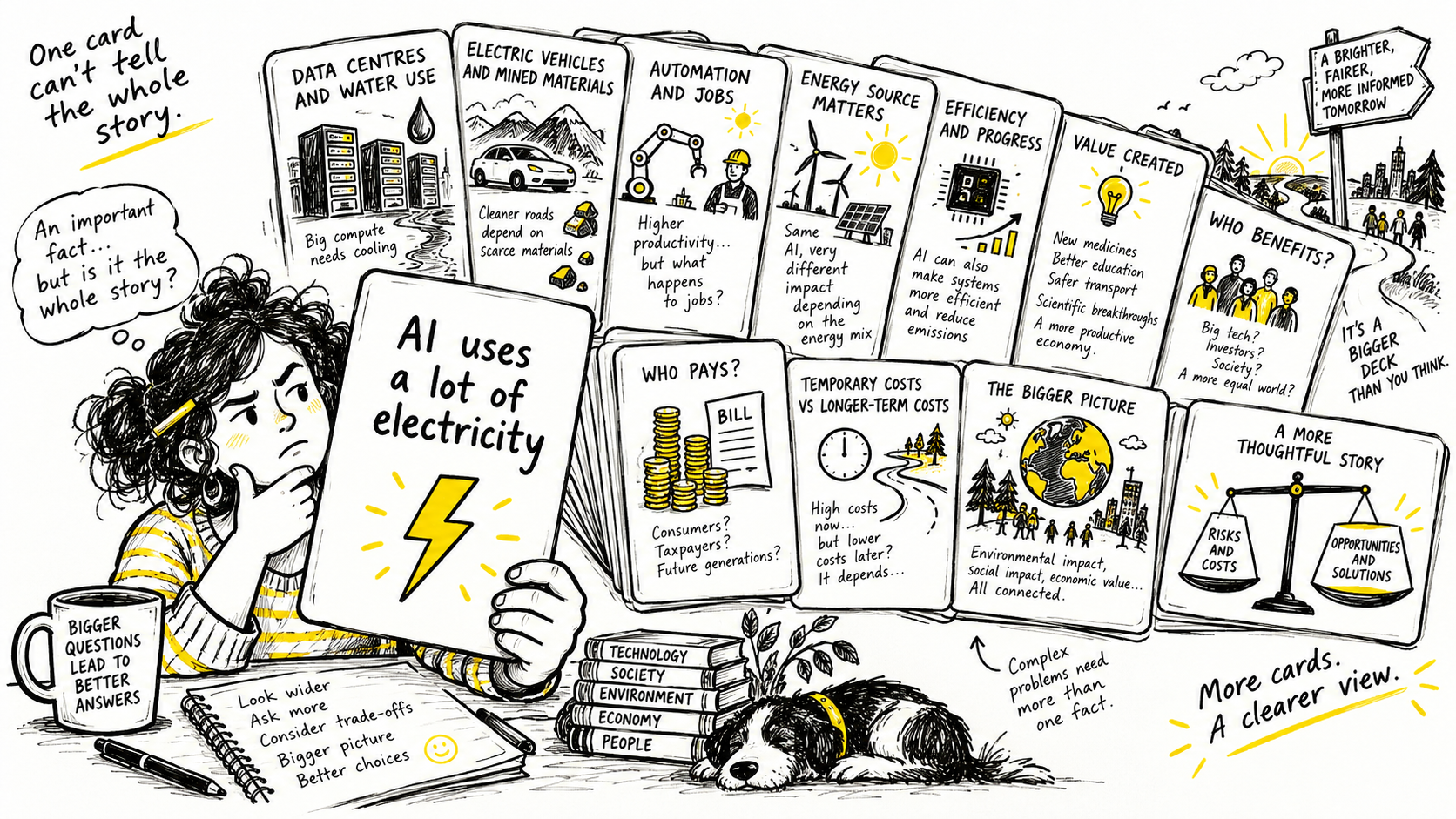
What technology gives us, what it takes from us, and whether we’re still conscious enough to choose the trade-off.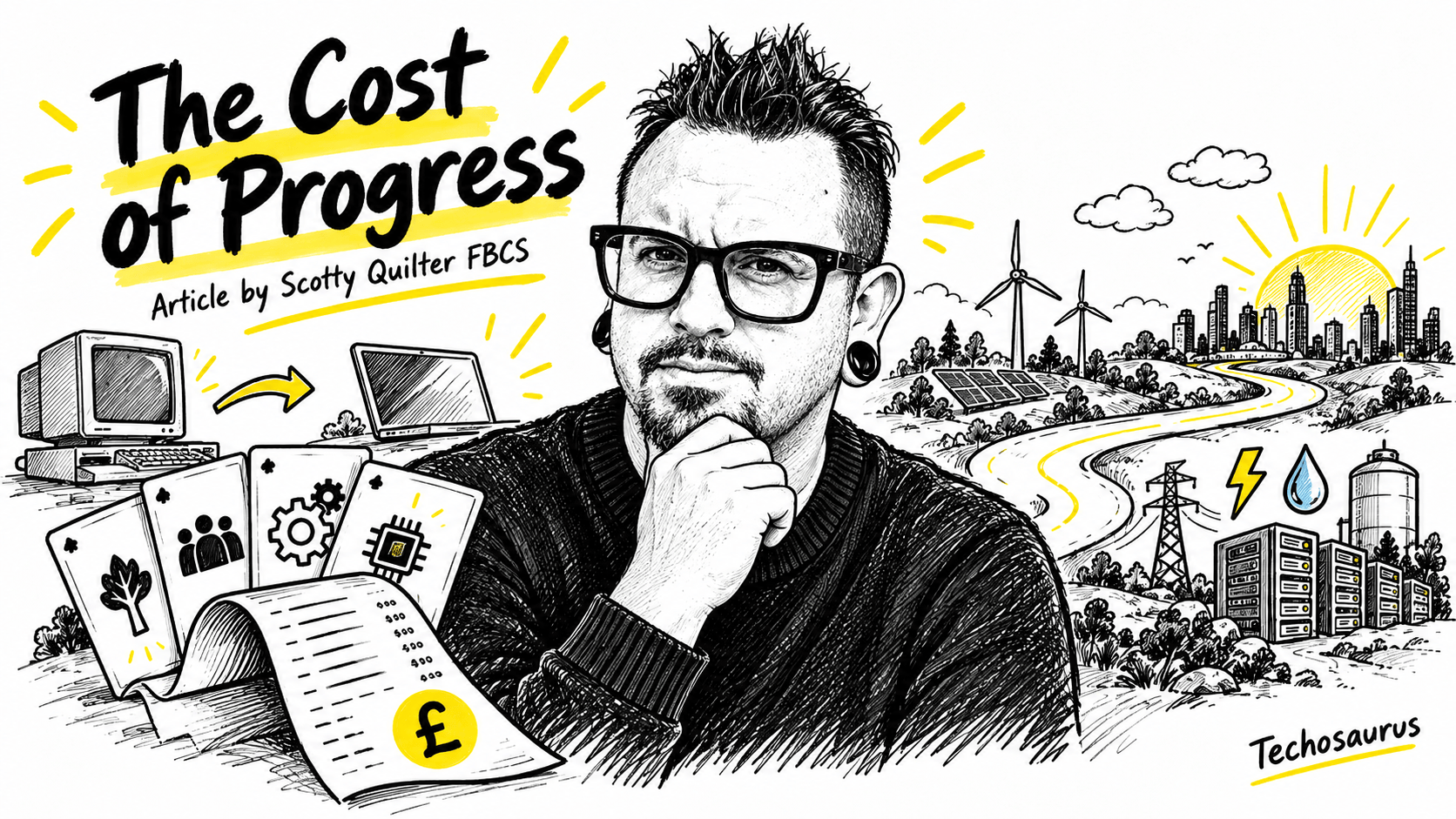 I keep coming back to the same question when I listen to the arguments people are having about AI and modern technology: what did progress give us, what did it take from us, and are we still conscious enough to choose the trade-off?Progress has never been free. Almost every meaningful technological advance has arrived with a bill attached to it. Sometimes that bill is obvious, sometimes it sits somewhere out of sight, and sometimes we only notice it once we’ve already built our lives around the thing that created it.And I think that’s where some of our conversations about technology become a bit strange. When something is new, we tend to see its downsides very clearly, but once it becomes familiar, useful and convenient, those same costs seem to fade into the background. That’s worth remembering as we work out what we actually think about AI.## The problem with one fact cardA lot of arguments about new technology begin with one fact. AI uses a lot of electricity. Data centres use water. Electric vehicles need mined materials. Automation changes jobs.Those concerns can be completely legitimate. We should understand them, scrutinise them and expect the companies building these technologies to keep improving. The problem starts when we pick up one fact card and behave as though we’re holding the entire deck.Energy use matters. So does what that energy is being used to achieve, where it comes from, how efficiently it is being used, who benefits from it and who eventually carries the bill. How much value are we getting for that cost, and who is actually paying it? Which parts can we improve? Which costs are temporary because the technology is immature, and which ones are likely to remain?That’s the conversation I want us to have. I want us to look at the whole deck rather than deciding what we think from the first card we’ve picked up.
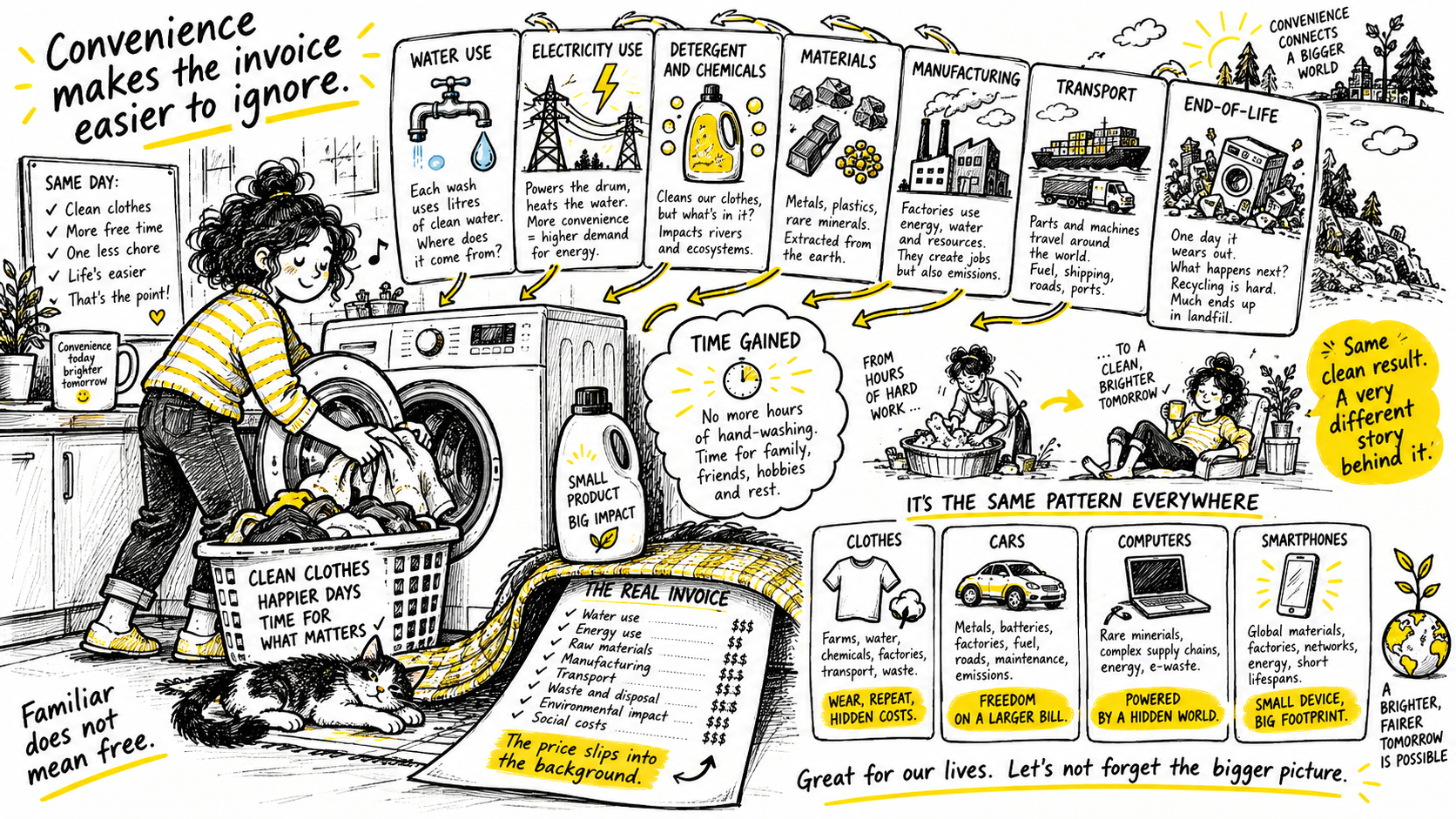
 ## Convenience makes the invoice easier to ignoreTake something as ordinary as a washing machine. Nobody stands in their kitchen having a moral crisis about putting a load of clothes on, yet that machine still has an environmental footprint. It uses water and electricity, needs detergent, contains metals and plastics, had to be manufactured and transported, and eventually somebody will need to deal with it when it reaches the end of its life.The same machine also transformed domestic life. Hours of repetitive physical work disappeared from the weekly routine, giving people time to spend elsewhere, and as a society we broadly accepted that trade-off. Then the technology improved. Machines became more efficient, standards changed and manufacturers found ways to reduce parts of the bill.You can see the same pattern almost everywhere. Our clothes need water, energy, materials, factories and global supply chains. Cars gave us extraordinary freedom and changed the shape of our roads, towns and expectations around personal transport. Computers and smartphones changed how we work and communicate while creating huge demand for manufacturing, materials, electricity and digital infrastructure.Once the convenience becomes part of ordinary life, the invoice gets much easier to ignore. Convenience is very good at hiding cost, and the price slips quietly into the background.
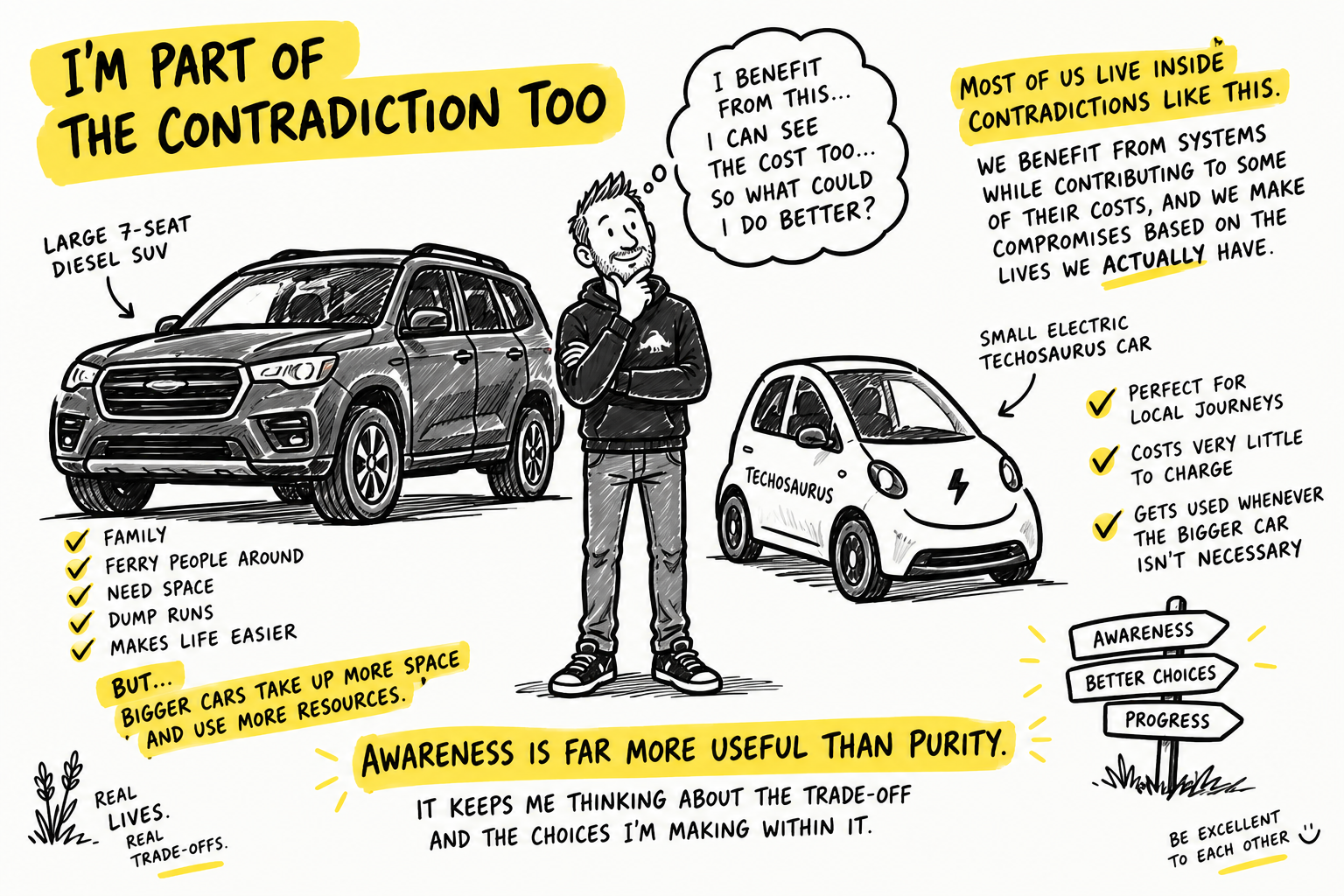
 ## I’m part of the contradiction tooCars are probably where I notice this most clearly in my own life. I drive a large 7-seat diesel SUV, and I can justify it pretty easily. I’ve got a family, I ferry people around, I need space, I do dump runs, and there are plenty of occasions where having a large car makes life considerably easier. I also know that bigger cars take up more space and use more resources.At the same time, we’ve got a small electric Techosaurus car that’s perfect for local journeys, costs very little to charge and gets used whenever the bigger car isn’t necessary.I’m hardly some model of environmental purity, and purity feels like a pretty poor test for how we make decisions about progress anyway. Most of us live inside contradictions like this. We benefit from systems while contributing to some of their costs, and we make compromises based on the lives we actually have, the families we support, the work we do and the options available to us at the time.For me, awareness is far more useful. I can look at something and say: I benefit from this, I can see the cost too, so what could I do better? That keeps me thinking about the trade-off and the choices I’m making within it.
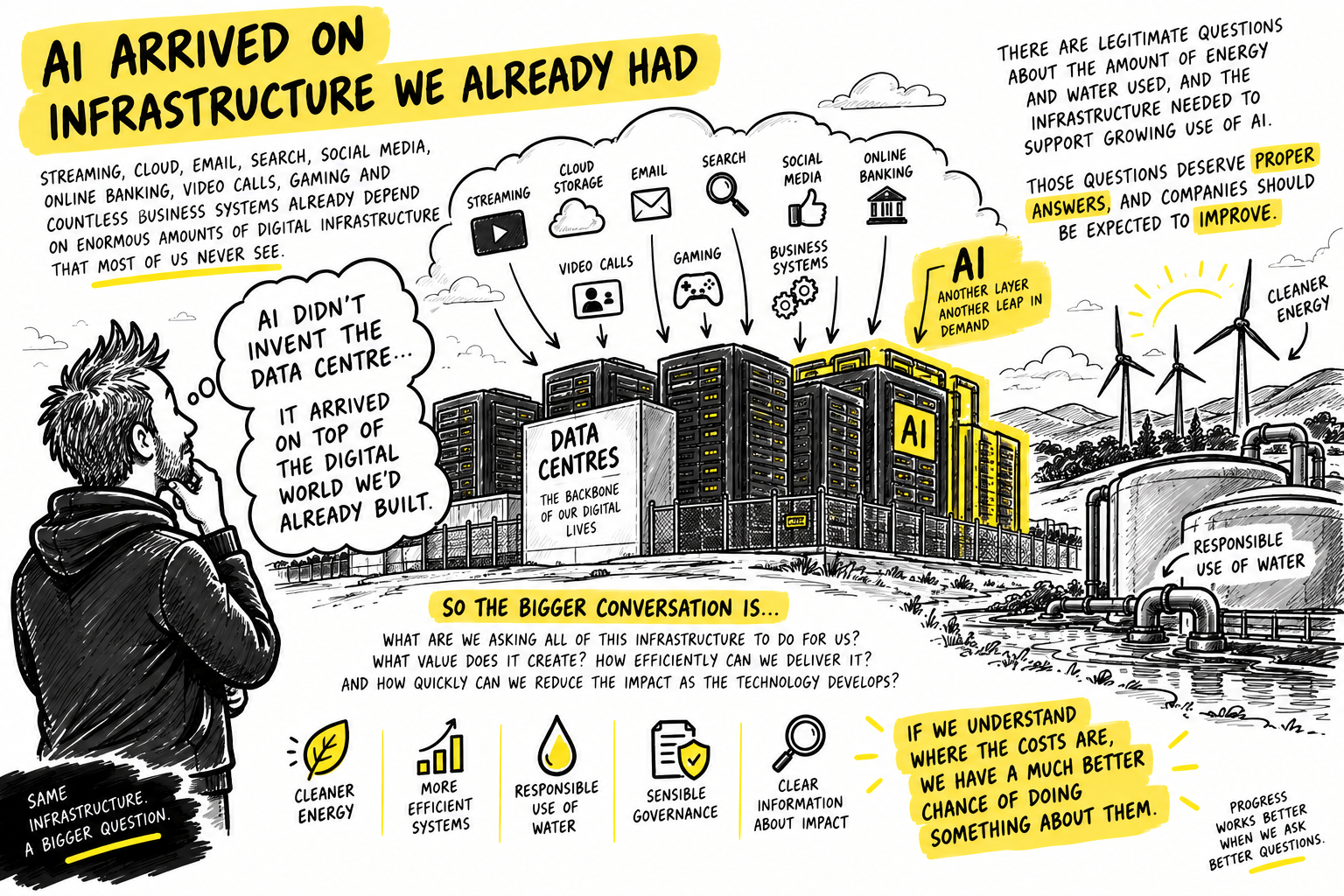
 ## AI arrived on infrastructure we already hadWhich brings me back to AI. There are legitimate questions about the amount of energy and water used by data centres and the infrastructure being built to support growing use of AI. Those questions deserve proper answers, and technology companies should be expected to improve the systems they’re building.Context matters here too. Streaming services, cloud storage, email, search engines, social media, online banking, video calls, gaming and countless business systems already depend on enormous amounts of digital infrastructure that most of us never see. AI has arrived on top of that existing digital world and is adding another rapidly growing source of demand.So I think the bigger conversation is about the resource cost of the digital world we’ve built and what we’re asking all of that infrastructure to do for us. What value does it create? How efficiently can we deliver it? How quickly can we reduce the impact as the technology develops?I want us demanding cleaner energy, more efficient systems, responsible use of water, sensible governance and clear information about the impact these systems have. If we understand where the costs are, we have a much better chance of doing something about them.
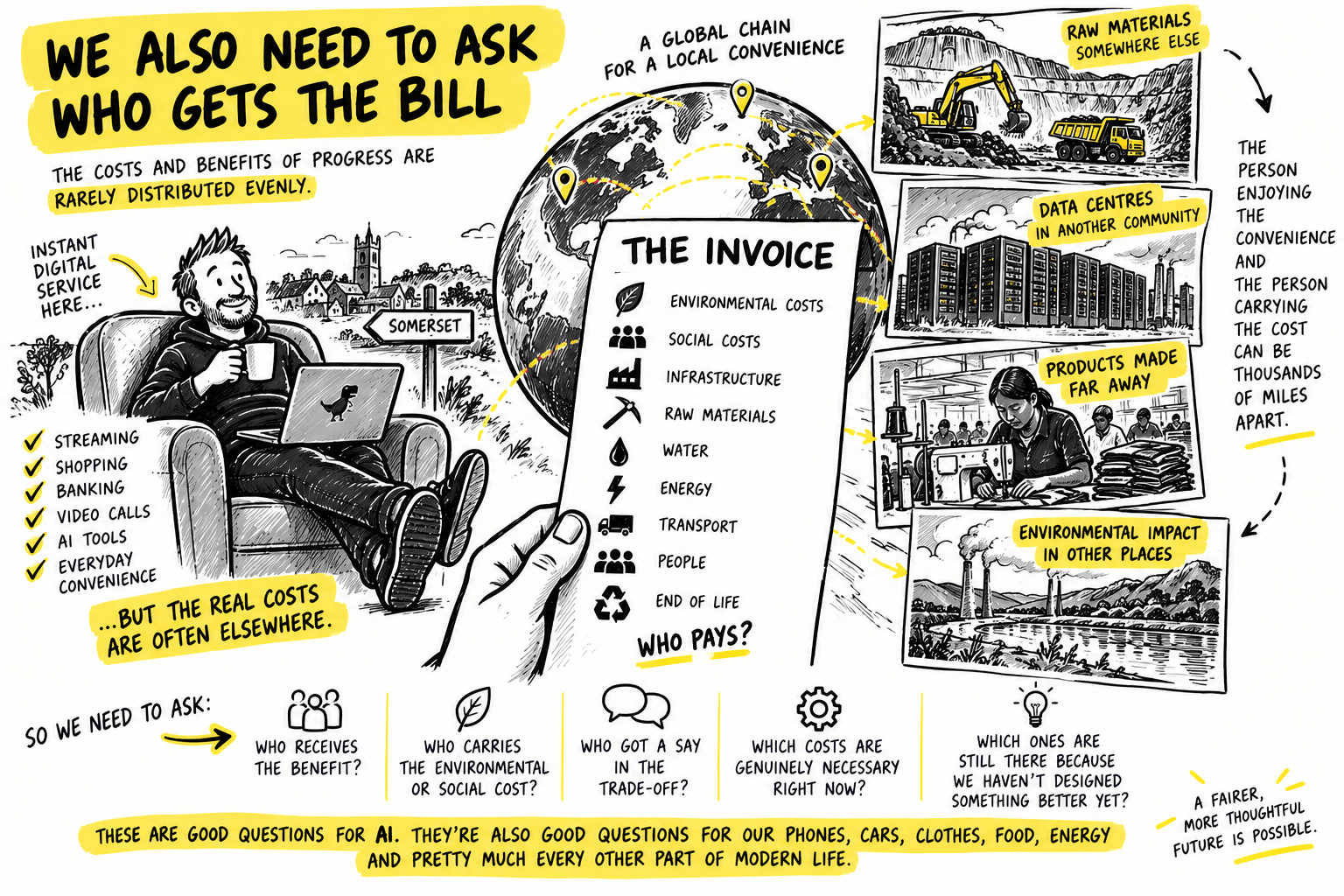
 ## We also need to ask who gets the billThere’s another part of this that matters just as much to me, which is that the costs and benefits of progress are rarely distributed evenly.I can enjoy an instant digital service here in Somerset while the physical infrastructure supporting it sits in somebody else’s community. I can buy a relatively inexpensive item of clothing without ever seeing where the raw materials came from, how much water went into producing it or what life looked like for the person who made it. The person enjoying the convenience and the person carrying part of the cost can be thousands of miles apart.So when we read the whole invoice, we need to look at the names on it too. Who receives the benefit, and who carries the environmental or social cost? Who got a say in the trade-off? Which costs genuinely come with the technology we have today, and which ones are still there because we haven’t designed something better yet?Those are good questions for AI. They’re also good questions for our phones, cars, clothes, food, energy and pretty much every other part of modern life.
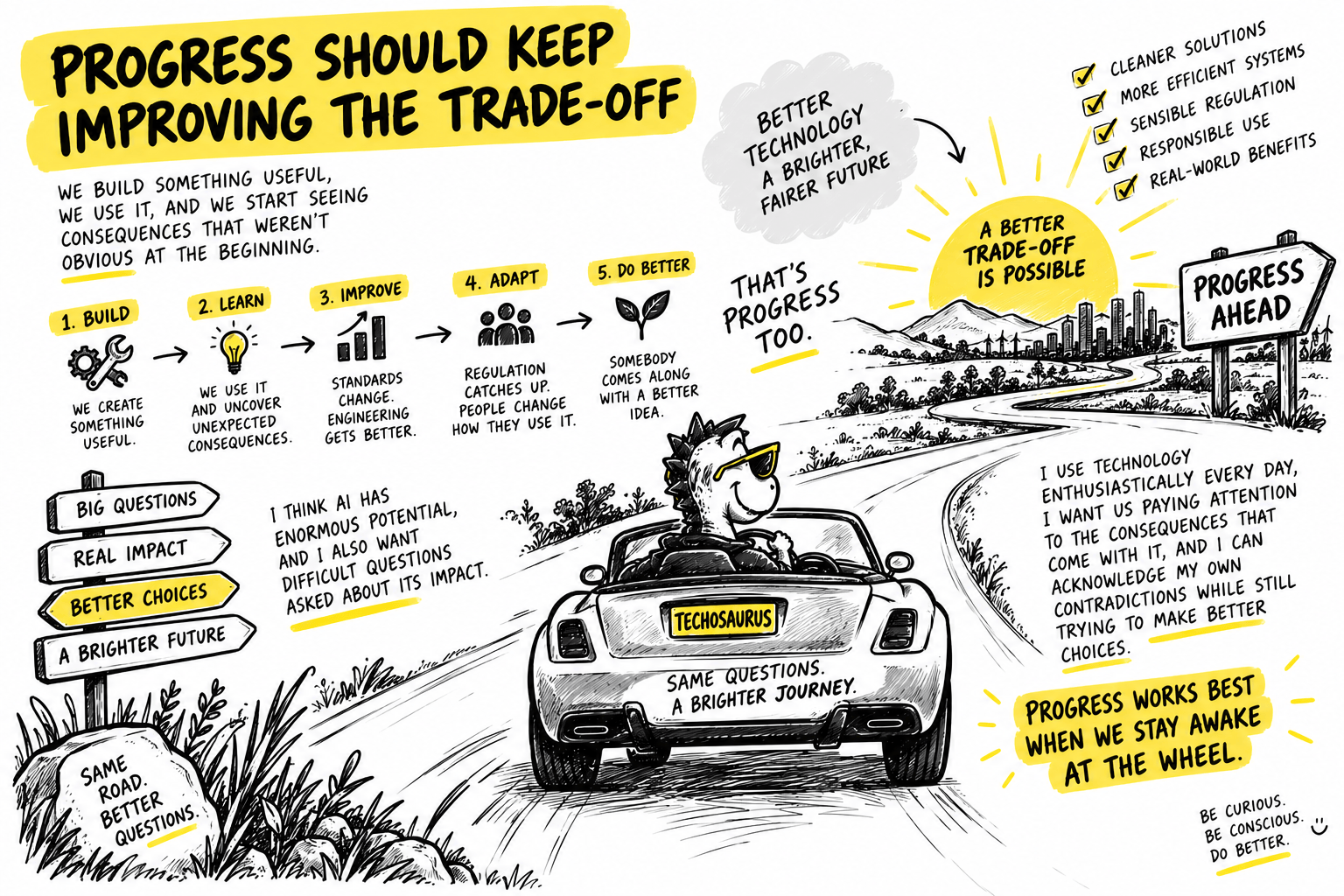
 ## Progress should keep improving the trade-offOne of the things I find encouraging about technology is that the trade-off can change. We build something useful, we use it, and we start seeing consequences that weren’t obvious at the beginning. Then standards change, engineering improves, regulation catches up, people change how they use the technology, or somebody comes along with a better idea.That’s progress too.And that’s probably the position I feel most comfortable with when it comes to AI. I think AI has enormous potential, and I also want difficult questions asked about its impact. I use technology enthusiastically every day, I want us paying attention to the consequences that come with it, and I can acknowledge my own contradictions while still trying to make better choices.Progress works best when we stay awake at the wheel.
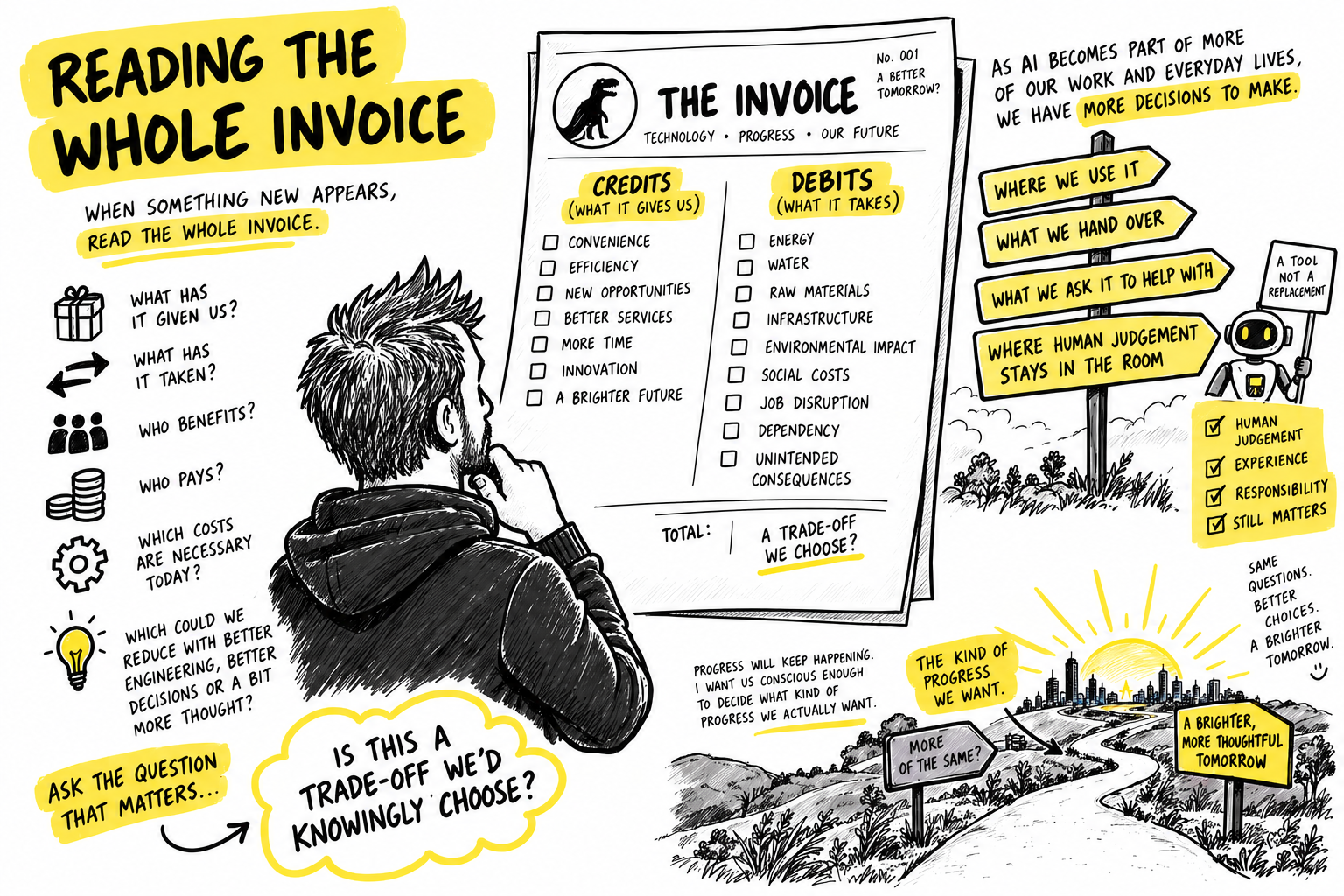
 ## Reading the whole invoiceThat’s the principle I keep coming back to. When something new appears, read the whole invoice. Look at what the technology has given us, what it has taken, who benefited, who paid, which costs are necessary today and which ones we could reduce with better engineering, better decisions or simply a bit more thought.Then ask the question that matters: is this a trade-off we’d knowingly choose?That feels particularly important as AI becomes part of more of our work and everyday lives. These tools are becoming incredibly capable, and we’re going to have more decisions to make about where we use them, what we hand over to them, what we ask them to help us with and where we want human judgement, experience and responsibility to remain firmly in the room.Progress will keep happening. I want us conscious enough to decide what kind of progress we actually want.
 —I’m exploring more of this thinking at LifeInAI in Plymouth on 23 September. My workshop, Do More Human Work: Finding the AI Opportunity in Your Working Week, looks at what we choose to hand to AI and what we deliberately keep human. Later in the day, my closing keynote, AI Gives Us Time. What Are We Going to Do With It?, takes that question a little further.Because if technology really does give us more capability and more time, we still get to decide what we do with it.