


Is AI the end of human creativity? What we learnt at Digital Somerset DS22: CTRL + CREATE
Bob Dylan, the shark from Jaws and a gym for your brain.
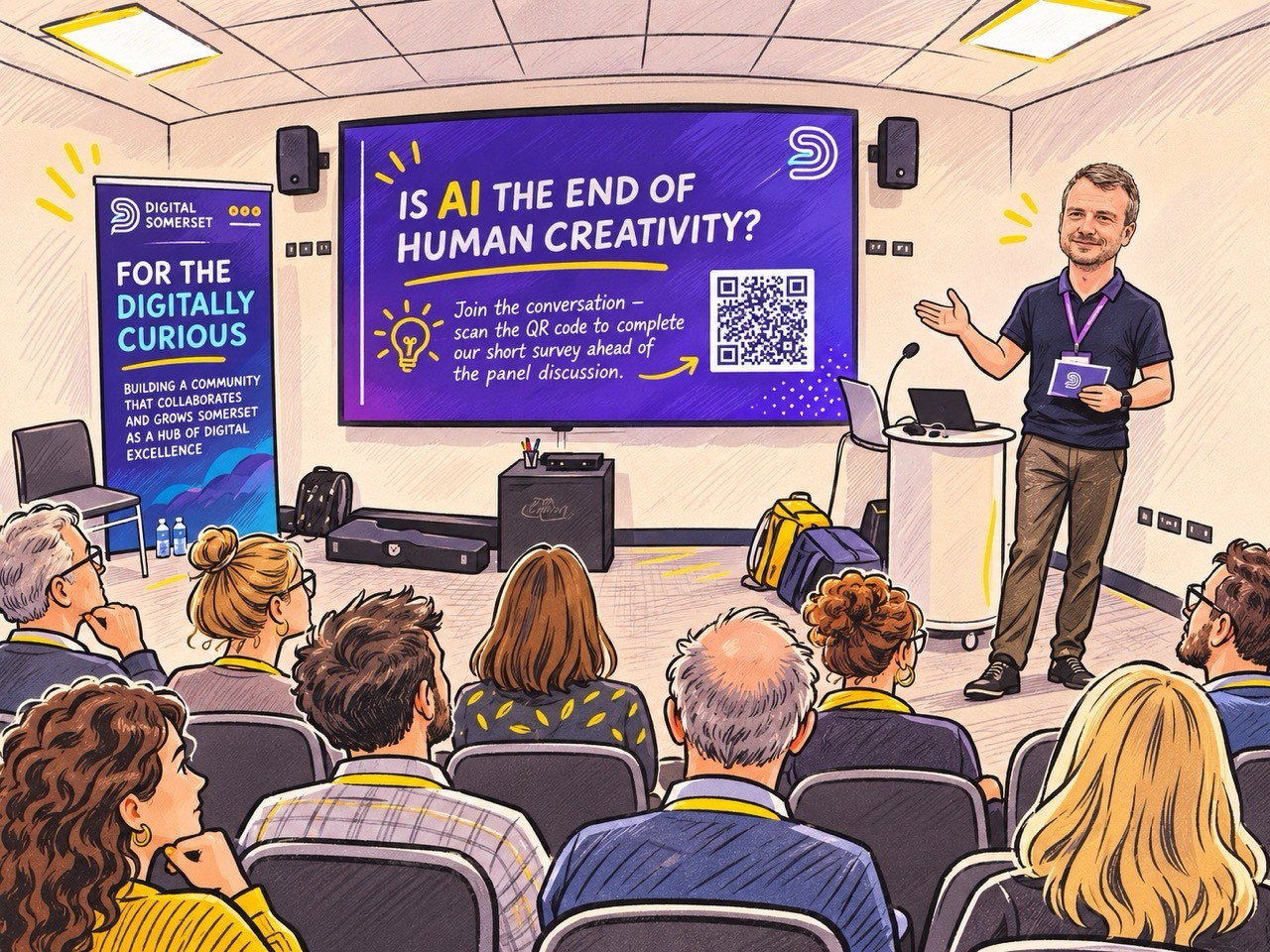
On 15 October, the Director of Innovation at Sony Music stood in front of a room full of people in Taunton and sang Bob Dylan. There was a perfectly sensible reason for this slightly unexpected turn of events. Tom Bellamy, who was with us in a personal capacity, wanted us to hear Boots of Spanish Leather, but playing the original recording could have created an awkward copyright conversation with his employer, so he decided to perform it himself. He then pointed out that the rights to the song itself belonged elsewhere, and joked that a rather shirty email would be waiting for him the following morning either way.
Then he played us a song made entirely by AI. It had the folk-ballad sound, the guitar, the singing and the sort of lyrics you might expect from an attempt to recreate Dylan’s early work. It even had a title, although Bring Your Living Heart wasn’t exactly giving Boots of Spanish Leather much competition in that department. Tom said the machine was definitely the better singer and guitarist, at which point the room rather kindly disagreed with him.
That was one of the opening demonstrations at Digital Somerset’s DS22: CTRL + CREATE, held at the Firepool Centre for Digital Innovation. The question for the evening was Is AI the end of human creativity? We had music, a composer who was quite happy to say he didn’t want generative AI anywhere near his studio, a lawyer dealing with the increasingly complicated questions of creative ownership and an audience that was more than willing to challenge us. By the end, we’d also covered cooking, the shark from Jaws, the danger of making life too easy and why we might need a gym for our brains.
For anyone unfamiliar with Digital Somerset, we’re a volunteer-led group bringing together the county’s digitally curious people, whether they work in technology, run a business, teach, study or simply want to understand what’s happening around them. Paul Smith from UCS College Group hosted the evening and Amy Ralston, Partner at Stephens Scown and Chair of Digital Somerset, led the panel. Stephens Scown were the event’s main sponsor and provided the pizza, which meant the usual conversations beforehand came with a slice in hand. It was lovely to see students alongside people from the local business and creative communities. Paul also reminded everyone about Donate IT, which helps give unwanted technology a useful second life. And, as the evening drew to a close, Amy was still trying to persuade people to take the remaining pizza home.
What makes a song worth listening to?
Tom’s presentation began with a bit of music-industry history. He’d worked on everything from The X Factor and Now That’s What I Call Music! to catalogue campaigns for artists including Primal Scream, the Stone Roses and Manic Street Preachers, so he’d seen the relationship between technology and the music business from a few different angles. He took us through the arrival of Napster, legal digital downloads and then streaming, each of which forced the industry to work out what to do when the way people listened to music changed.
Generative AI had brought another version of that problem. Tools such as Suno and Udio could produce complete pieces of music from a written instruction, including the vocals, instruments and lyrics. That was an extraordinary technical achievement, and it came with some very difficult questions about what the systems had been trained on and whose work had helped make the results possible.
Tom was careful to explain that the opinion he was about to give was his own, and that he wasn’t speaking for Sony Music. His line was one of the best of the night: “Mimicking human speech is not the same as having something to say.”
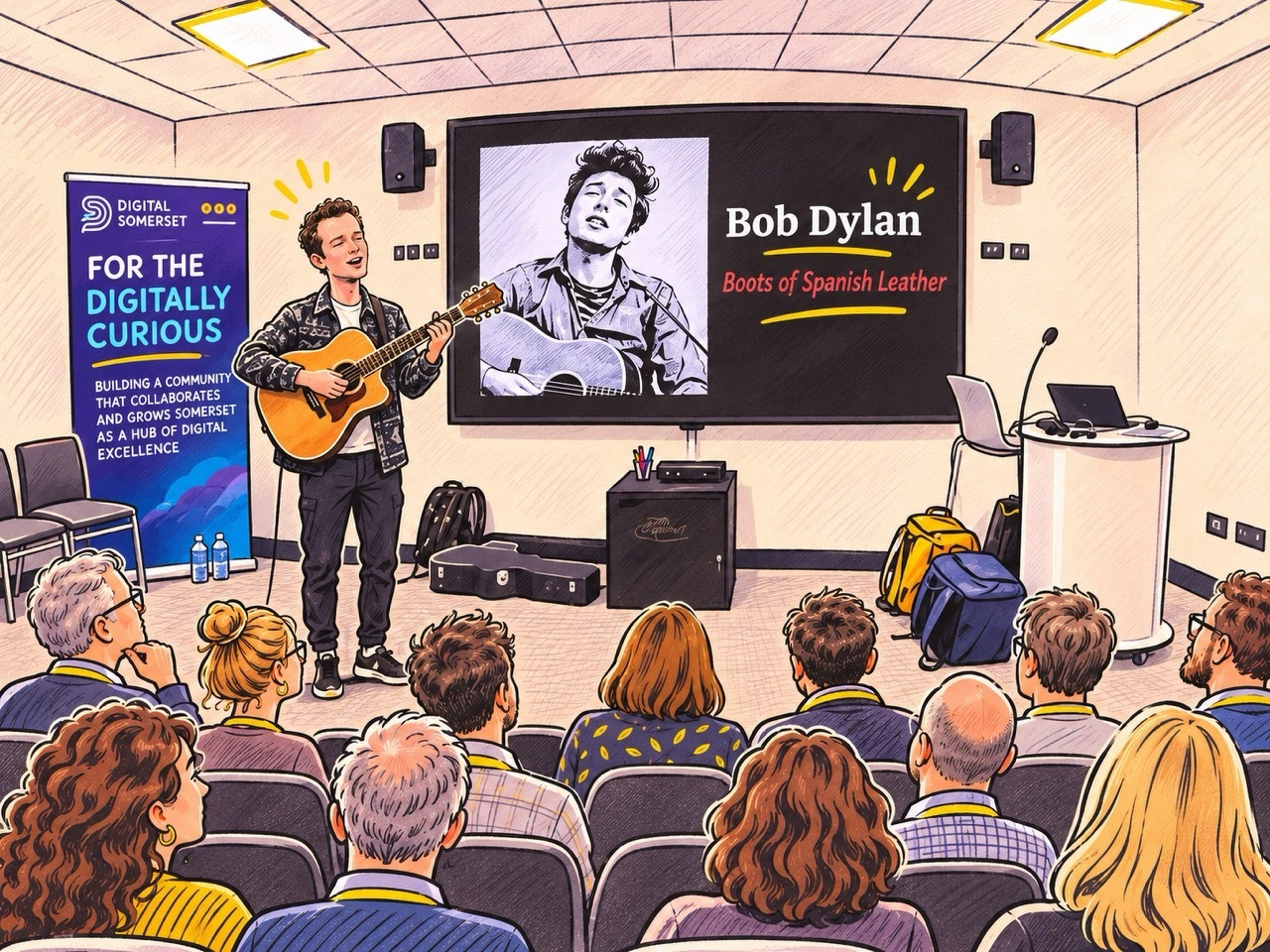
After the Dylan performance and the AI-generated song, he asked everyone to think of a piece of music they loved. Then he asked whether discovering that it had actually been created by a machine, with no human input, would change how they felt about it. Hands went up, enough for Tom to conclude that the yeses had it.
I found that response fascinating. The song in the hypothetical example was exactly the same song, with exactly the same sound coming out of the speakers. All that had changed was what the listener knew about its origin. Tom compared it to discovering that the Mona Lisa in the Louvre was a really clever forgery. The painting might still look identical, but the story behind it, and the value we placed on it, would have changed dramatically.
When Tom listened to Dylan, he pictured a young man sitting on his own in Greenwich Village, with experiences and feelings that had found their way into a song. The AI could reproduce the musical patterns, but Tom felt there was a human connection missing. And I could see why he felt that way. Think of a song that reminds you of somebody, a gig you went to or a period of your life. Quite often, the story around the music becomes part of what you love about it.
He also brought the conversation back to business. In his view, the organisations that would get the best results from AI were the ones that understood what their people did and made their own knowledge useful to the technology. Everybody had access to the same AI tools, so the judgement and understanding a business brought to them was what would set it apart. It was a practical point, and one that would keep cropping up in a rather different form throughout the evening.
Cooking, creativity and the shark from Jaws
Next up was Jono Buchanan, an award-winning composer, producer and music technology educator at the Guildhall School of Music & Drama. His career has included songwriting and remix work for artists including Whitney Houston, Pet Shop Boys, Shania Twain and LeAnn Rimes, and his presentation started with a brilliant admission: he’d turned up as the musician without anything to play, only to find that the man from Sony had just given everyone a live performance.
Jono wanted to talk about what creativity actually meant, and he did it by talking about cooking. When you first try a new recipe, you carefully measure the ingredients, follow the instructions and hope the result looks something like the picture. Make the same dish 15 times, however, and you start doing things differently. You know which ingredient to leave out, what you can substitute and how much spice your family can cope with. Eventually, you’ve made it yours.
It was a lovely way of explaining how knowledge and experience build into creativity. Jono had started playing the violin at 5, initially producing noises that made his parents run out of the house. Over time he learnt instruments, listened to other musicians, developed his own tastes and gradually built up the musical ingredients he could draw on. A composition was full of choices that reflected everything he’d heard and experienced along the way.
He then moved on to film music, and Jaws provided one of the most entertaining examples of the night. Jono described the composer as the quieter second storyteller, the person who could tell an audience that something was coming, or that a seemingly unimportant character might matter later. In Jaws, he argued, the music effectively became the shark. You heard the danger before you saw it. Take away the soundtrack and suddenly you’ve got an awful lot of people kicking their legs in the sea.
That was the part of composing Jono loved. He got to choose when an audience should feel anxious, when it should relax and when the music should stay out of the way completely. The decisions were the interesting bit, and he’d spent his life learning how to make them.
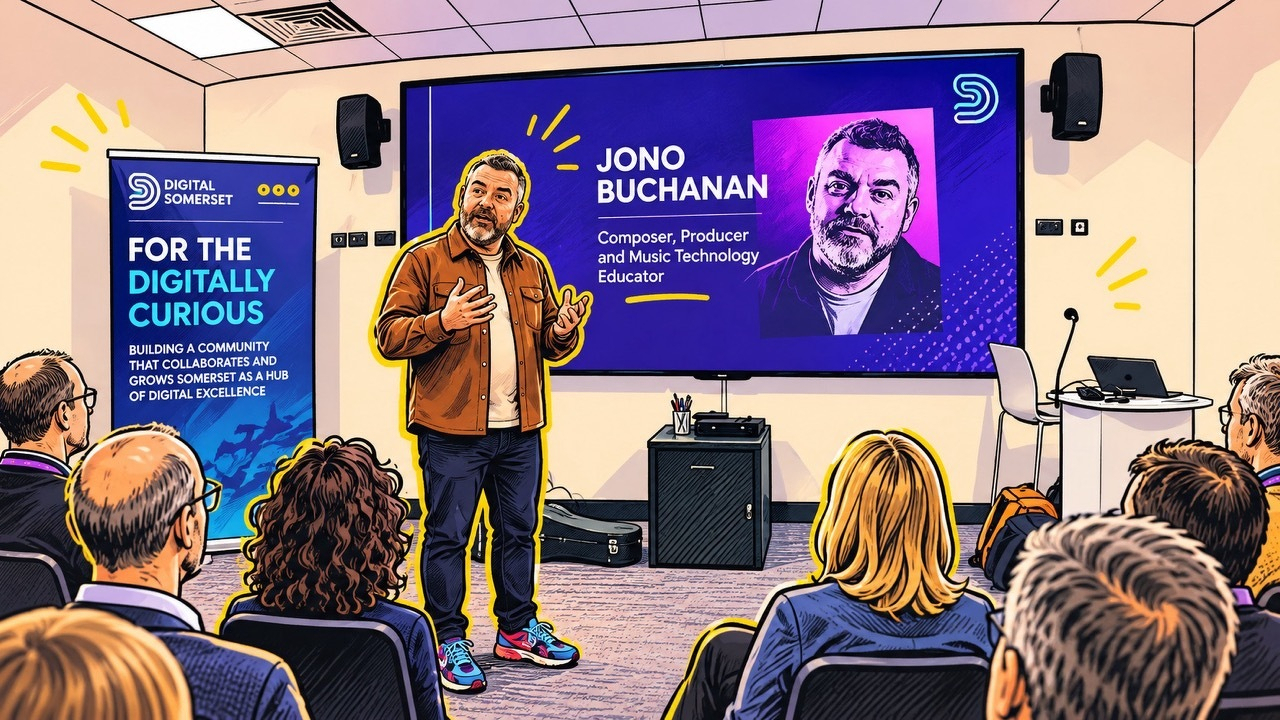
Jono was very clear that he didn’t want generative AI doing that work for him. He used computers and music technology extensively, including Logic Pro and libraries of recorded sounds, and he regarded those as instruments he could learn, shape and play. A system that generated the finished piece for him took away the very decisions he enjoyed making. He even suggested that most people turned to AI-generated music out of laziness, which was a fairly bold thing to say to a room full of people attending an AI event.
But his argument had some depth. He enjoyed searching for a sound, discovering that something didn’t work, going back the next day and trying again. That effort gave him a personal relationship with the finished piece. You could disagree with where he drew the line, and I did in places, while still appreciating why he was so determined to protect it.
Four people on stools, and some very good questions
After a short break, Amy brought Tom and Jono back to the front, alongside Joey Medway from Stephens Scown’s intellectual property, data protection and technology team, and me, representing Techosaurus and the Digital Somerset board. Somebody in the audience later pointed out that the 4 of us sitting on stools looked like a boy band. I suspect the resemblance ended at the furniture.
We’d also asked people to share their views through a survey. There were 21 responses at the interval, and Amy reported that the mood seemed broadly positive about AI’s potential to help people be creative. That was an interesting starting point given some of the strong opinions we’d just heard, and the questions soon made it clear that the room had plenty of its own ideas. One question asked whether a flood of machine-generated music would make human-created work more desirable. Tom talked about the volume of AI tracks arriving on streaming platforms such as Deezer, and made the useful distinction between music being uploaded and music people actually chose to listen to.
Amy asked me how AI could make a positive contribution to creativity. Through our work at Techosaurus, we’d met people with wonderful ideas who’d never had the confidence, resources or technical skills to turn those ideas into something they could share. AI had encouraged some of them to have a go. That mattered to me, because getting somebody to try something they’d previously ruled out was a pretty good outcome in itself.
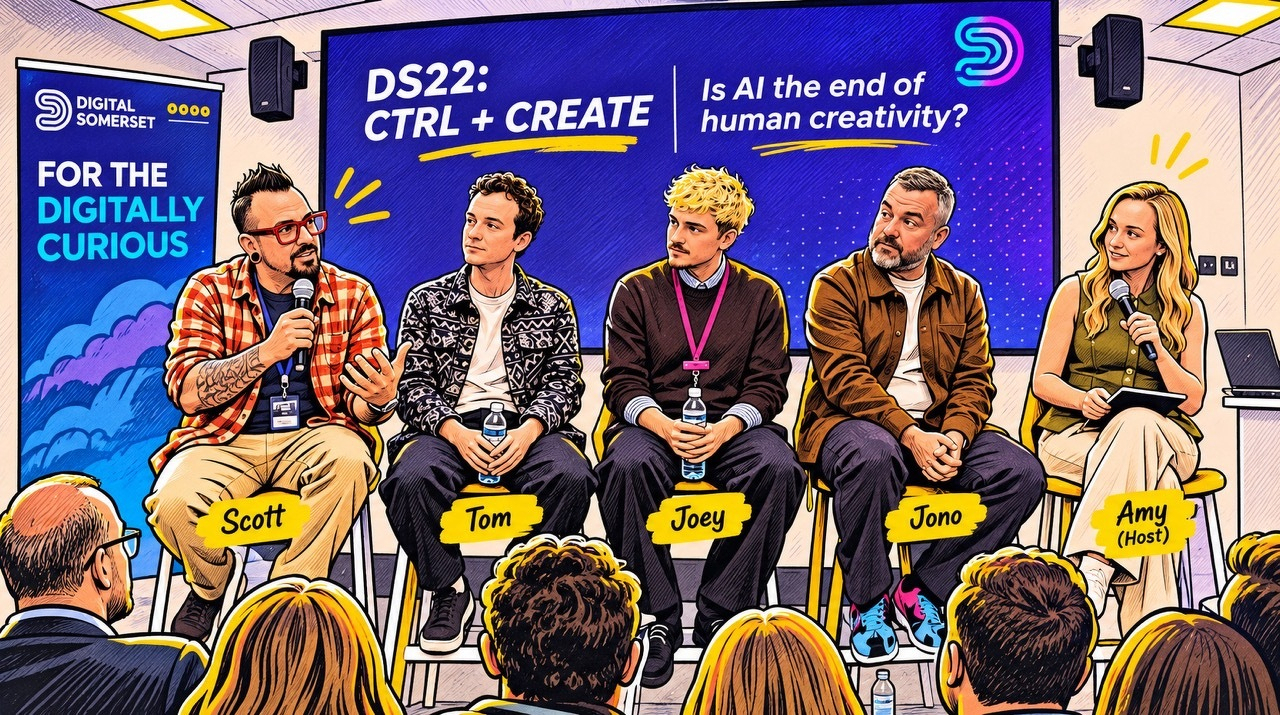
But I also made the point that accepting the first thing a system generated was a missed opportunity. If everybody typed a basic request into the same sort of tool and took whatever came back, where was their personal contribution? I’d rather ask somebody: if AI did 80% of the work, what did you bring to the result that nobody else could? It’s a question that gets people thinking about the taste, experience and judgement they bring to their work. Tom knew what he was trying to achieve when he wrote his Dylan prompt. Type “Make me a song about a monkey in a tree” and take whatever comes back, and I can’t see any creativity in that at all.
We also explored whether these tools could make music and other creative activities more accessible to people who couldn’t afford expensive equipment or years of tuition. Jono acknowledged that point. His challenge was to think about what people actually chose to do once they had access. The technology could open a door; the decisions made after walking through it still mattered.
Then came the legal questions. Joey explained that anyone creating work with AI needed to think about the terms of the tool they were using, who might have contractual ownership of the output, whether it attracted legal protection and whether someone else’s rights might have been infringed. Those were separate questions, and the answers could depend heavily on how the work had been made.
Tash added one of the best audience interventions of the evening by borrowing a line from Whitney Houston: “How will I know?” If someone claimed they’d written a song, how could a listener or buyer tell whether they really had? Jono explained that some of his professional contracts required him to confirm that AI hadn’t been used in the music he supplied. We discussed declarations, watermarking and attempts to trace where digital content came from, although proving the history of a creative work was clearly going to be a complicated business. It brought us straight back to Tom’s question about why provenance mattered.
Another audience member asked Jono whether he’d use AI to critique a piece of music he’d written. Perhaps it could point out a problem or suggest what needed fixing. Jono’s first answer was a beautifully direct “No”, followed by laughter and a much longer explanation. If he’d spent 5 days wrestling with a composition, he wanted to be the person who worked out what was wrong, or even the person who decided it couldn’t be fixed. For him, that struggle was part of making the music.
Towards the end of the night, another audience member asked a particularly good question about sampling. Musicians had made some incredible records by borrowing, cutting up and rearranging sounds, so could Jono see a future where generative AI had a place in that creative process too? Jono admitted that his position sounded hard-line and softened it a little. He talked about Fatboy Slim and Praise You, where the choice of an old sample, and what Norman Cook heard in it, helped make something new. He also offered a wonderful film example that had come out of a chat with Bill, one of our audience, before the panel: if an enormous Star Wars battle scene had accidentally included somebody’s Winnebago in the background, using AI to remove the vehicle probably wouldn’t spoil the film for anyone.
That was one of my favourite exchanges. Jono had a clear personal boundary around the things he wanted to create himself, but he was prepared to explore the awkward edges of that position when somebody challenged him. We ended up with a far more useful discussion than we would have had if everyone had politely agreed with each other.
What happened when we made everything easier?
The conversation also went well beyond music, into education, entry-level work and the experience of learning. One question asked what happened to the skills people traditionally developed in junior roles if more of that work could now be done by machines. I thought that was a fair concern. Technology had been changing jobs and the way people entered professions for generations, and AI had become the latest, very visible focus for those worries.
I even brought up an old Tom and Jerry cartoon, Push-Button Kitty from 1952, in which a robot cat was brought in to do Tom’s job. As he packed up and left the house, he was told, “That’s how it is, Tom, progress. The machine age and stuff like that.” It got a laugh, but there was a point behind it. Each generation had watched some familiar work change or disappear, and we’d also seen new kinds of work emerge. We needed to think seriously about how people would gain experience as those starting points changed.
Jono then spoke about teaching young musicians and how vulnerable the creative process could be. He talked about young people seeing the finished, polished version of everything online, then feeling they ought to be able to produce something equally good immediately. It was a difficult standard to live up to, particularly when the work people saw rarely showed the hours of mistakes, revisions and experiments that had gone into it.
That took me into a subject I’ve been talking about a lot recently: friction. We’d spent years removing little inconveniences from everyday life. We could stream practically any song or film we wanted, the moment we wanted it, and scan our own shopping without speaking to anybody. These things were useful, and I happily used plenty of them. But I wondered what happened when we started expecting that same instant result from activities that required practice, patience and a willingness to get things wrong. I also asked what we were racing towards with all this saved time. If every convenience just left room for another task, where did the space to enjoy making something actually go?
I spoke from my experience as a parent, too. I’d seen how much pressure young people could feel to measure up to the polished versions of life they saw around them. And that mattered when we were talking about education, because a tool capable of giving somebody a finished answer in seconds also gave them the choice to skip some of the thinking that would have helped them learn.
An audience member asked whether using AI to learn a musical instrument was different. I thought that was a brilliant example of how people could use the technology well. If you asked AI to explain a chord, suggest an exercise or help you understand a technique, you were still the one learning to play. The effort was yours. You were using the tool to develop a skill, and there was an important difference in the outcome compared with asking it to make all the music for you.
That led me to ask something I’ve kept thinking about since: “What’s the equivalent of gym for the brain?” We deliberately go to the gym to exercise bodies that modern life often gives fewer reasons to work physically. As more of our jobs involve thinking, communicating and making decisions, what happens if we hand too much of that work to a machine? What do we choose to keep practising, even when the shortcut is available?
Somewhere in that discussion, the conversation turned back to vinyl records, cassettes, mixtapes and the pleasure of owning a physical piece of music. One audience member said that when they loved a song, they wanted to find out who the artist was, watch them perform and understand their story. Others talked about the artwork, the lyrics printed on the sleeve and the care that went into making a mixtape for someone. It was a lovely reminder of why Tom’s opening question had landed so well. A piece of music could mean something to us because of everything around it as well as the sound itself.
A conversation worth carrying on
By the end of the panel, we hadn’t arrived at one neat answer to whether AI would end human creativity. I didn’t expect us to, and I’m glad we didn’t. Tom cared about the human story behind the music, Jono cared deeply about the experience of making it, Joey had shown how difficult ownership and authorship could become, and I’d been interested in what happened when these tools helped somebody find abilities they hadn’t previously been able to use. The room had challenged all of us along the way.
One particularly pleasing outcome was that the conversation with Jono was going to continue. Since the event, we’ve agreed to work with him again. We’re going to share a recording of Jono on our upcoming podcast, interview him separately for future episodes, and hopefully collaborate on some articles as well. Given how much ground we covered that evening, I’ve got a feeling there will be plenty to talk about.
A big thank you to Tom, Jono and Joey for giving us their time, and to Amy for chairing the discussion and Paul for keeping the evening moving. Thanks also to Stephens Scown for sponsoring DS22 and keeping us all fed, to our partners and fellow Digital Somerset volunteers for doing the work that makes these evenings possible, to the Firepool team for hosting us, and to everybody who turned up, asked a question or offered a different view.
The evening had started with a machine writing a song. It ended with a room full of people asking better questions than the ones we’d arrived with. I thought that was a pretty good answer.
Next up: DS23 – Women in Tech 2027
And if you fancy joining us for the next conversation, Digital Somerset will be back on Thursday 21 January 2027 for DS23: Women in Tech, our first event of the new year.
We’ll be returning to the Firepool Centre for Digital Innovation in Taunton, bringing together people from across Somerset to celebrate the women working in technology, share their experiences, and explore the opportunities and challenges facing the industry. We’ve got some excellent conversations planned, with speakers and panellists to be announced soon.
The evening runs from 5.30pm to 8pm, with Early Bird tickets priced at £15 until 21 December, rising to £25 afterwards.
You can find all the details and ticket updates here: DS23: Women in Tech 2027.
Hopefully we’ll see you there!